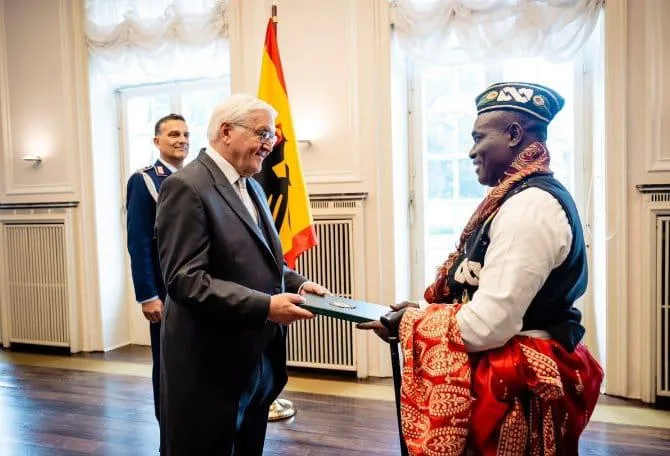
President Bola Tinubu and his German counterpart, Frank-Walter Steinmeier, have discussed ways to deepen economic cooperation between Nigeria and Germany, with emphasis on power, agriculture, migration, technology and industrial development.
The discussions took place during a bilateral engagement involving both countries, with the two leaders also reviewing existing diplomatic relations and opportunities for greater collaboration.
According to a statement by Nigeria’s Ambassador to Germany, Senator Ita Solomon Enang, the talks covered several areas of mutual interest, including off-grid power technology, the Siemens power project, agriculture, food production, migration and consular matters.
The two sides also considered a proposed Nigeria-Germany migration framework that would create opportunities for skilled Nigerians in fields such as medicine, information technology, artificial intelligence, technology, crafts and other areas of the German economy.
Another major focus was industrialisation, with Nigeria seeking German investment in automobile assembly plants that would enable cars, trucks and machinery to be assembled locally rather than imported as completely built units.
The initiative, according to the statement, is expected to support technology transfer, build local capacity and create more economic opportunities for Nigerians.
The discussions also touched on Nigeria’s leadership role in the Economic Community of West African States (ECOWAS), with Germany expressing support for efforts to strengthen regional cooperation and encourage countries that have withdrawn from the bloc, including Sahelian states, to return.
The statement said both countries recognised the importance of stronger regional coordination in addressing security challenges across West Africa.
Energy cooperation was also discussed, particularly German interest in supporting efforts to harness gas currently being flared in the Niger Delta and other oil-producing fields for electricity generation.
The possibility of increasing Nigeria’s oil-related economic engagement with Germany was equally considered.
Enang said the meeting also revisited Germany’s role in the implementation of the Green Tree Agreement following the International Court of Justice judgment on the Nigeria-Cameroon land and maritime boundary, including issues surrounding Bakassi and the humanitarian challenges arising from boundary demarcation.
The Nigerian Ambassador expressed appreciation to the German government for humanitarian assistance recently conveyed by German Foreign Minister Johann Wadephul during a courtesy visit to Nigeria’s Minister of Foreign Affairs, Ambassador Bianca Ojukwu.
The meeting further highlighted the cordial relationship between Tinubu and Steinmeier, with both sides emphasising the importance of regular high-level visits and continued engagement between Nigeria and Germany.
The bilateral meeting was attended by designated federal ministers and other members of the German government, as well as officials from the German Federal Foreign Office and the Nigerian Mission in Berlin.