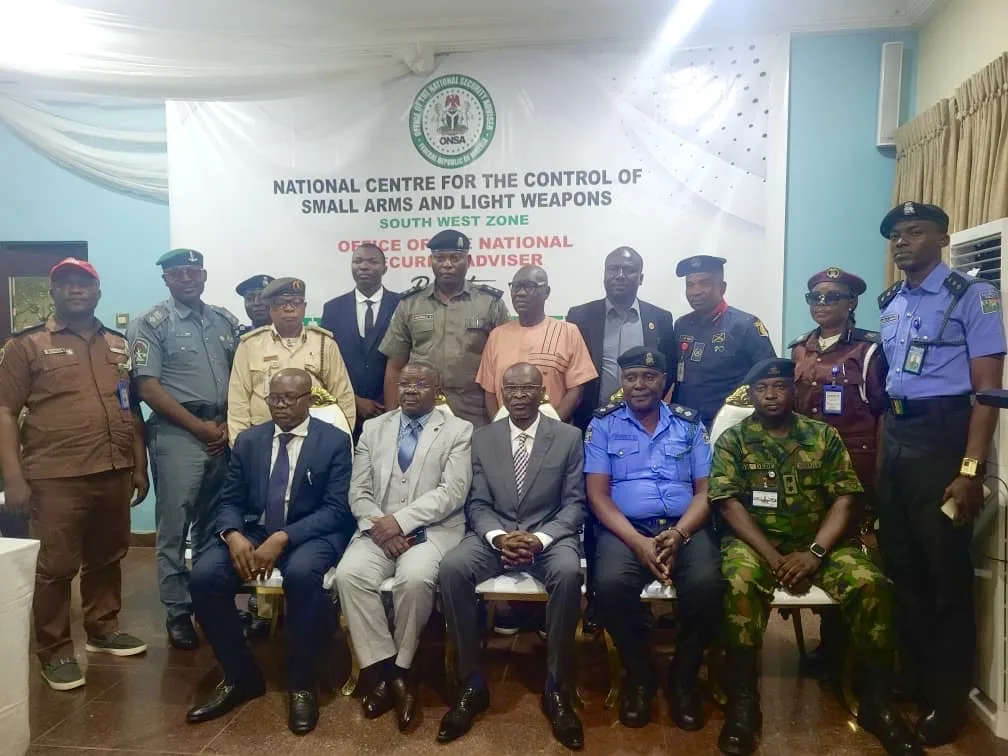
Security experts have raised fresh concerns over Nigeria’s worsening insecurity, attributing the trend to porous borders and weak control of small arms and light weapons, even as they warned that millions of illegal firearms remain in circulation, particularly in the South-West.
The experts spoke on Thursday at a one-day seminar on effective post-judgment management of small arms and light weapons held in Abeokuta, Ogun State.
Speaking with journalists, the South-West Zonal Director of the National Centre for the Control of Small Arms and Light Weapons, retired Commissioner of Police Abiodun Alamutu, said findings by the agency showed that the proliferation of illicit arms continued to fuel banditry, terrorism, and other violent crimes across the country.
He noted that a significant number of these weapons were in the hands of non-state actors, further worsening the security situation.
“Investigations have shown that the major enabler of insecurity, banditry, and terrorism in the country is the proliferation of small arms and light weapons, with a large chunk in the hands of non-state actors,” he said.
Alamutu stressed the need for a coordinated, community-driven approach, calling for collaboration with traditional rulers, civil society organisations, and community leaders to encourage the voluntary surrender of illegal arms.
He added that the agency was considering recommending amnesty for individuals willing to surrender such weapons, subject to approval by relevant authorities.
The retired police chief, however, dismissed claims of widespread open display of sophisticated weapons such as AK-47 rifles in the South-West, insisting that such acts would not be tolerated under the current security framework.
He urged stakeholders to strengthen mechanisms for tracking and mopping up illicit arms, warning against complacency.
Alamutu further disclosed that although exact figures remained uncertain, estimates suggested that about five million illegal weapons could be in circulation within the South-West.
“Some claim the estimate is up to five million. While we cannot state categorically, available records suggest it is within or even above that figure,” he said.
Highlighting ongoing enforcement efforts, he revealed that the Nigeria Customs Service had recorded significant interceptions at border points, including a recent seizure of 43,000 rounds of live ammunition.
Despite these gains, he identified porous borders as a major challenge, noting that the Federal Government was exploring technological solutions to strengthen border surveillance and curb arms smuggling.
Also speaking, the Ogun State Commissioner of Police, Bode Ojajuni, decried delays in handling recovered weapons, noting that many remained in police armouries for extended periods.
He called for a standardised nationwide framework mandating the regular transfer of seized arms to a central authority to minimise associated risks.
“We have many recovered arms in police armouries. There is a need for a structured system to ensure their timely collection and transfer,” he said.
In his presentation, a security expert and Head of Department of International Relations and Diplomacy at Chrisland University, Abeokuta, Dr Kunle Olawuni, criticised existing documentation and storage practices, describing them as weak and vulnerable to abuse.
He warned that poor record-keeping, prolonged storage of court exhibits, and weak inter-agency coordination could lead to theft, substitution, or re-circulation of seized weapons into criminal networks.
Olawuni recommended the deployment of a secure digital tracking system for recovered arms, linked to case files and court orders, alongside periodic audits and strict accountability measures. He also advocated the adoption of specialised armoury standards to ensure proper storage and monitoring.
Stakeholders at the seminar agreed that without decisive measures to recover illicit arms already in circulation, efforts to tackle insecurity across Nigeria would continue to face serious challenges