By Adesakin Adefemi
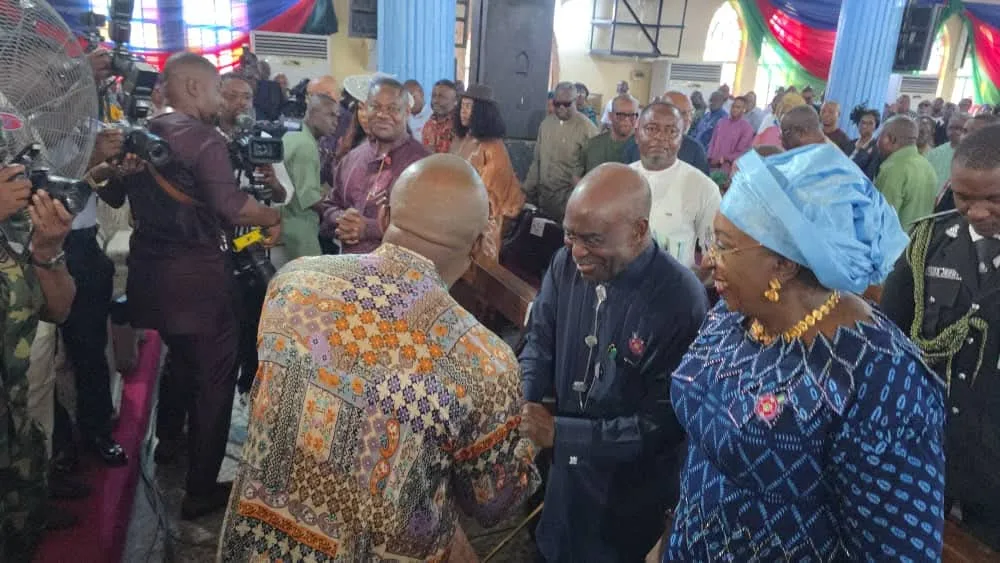
Governor Siminalayi Fubara walked straight from a private jet into St. Cyprian’s Anglican Church in Port Harcourt on Sunday, leading the Armed Forces Remembrance Day service, his first public appearance since the Rivers State House of Assembly filed a fresh impeachment notice last Thursday.
Dressed in formal black and flanked by Deputy Governor Prof. Ngozi Odu and senior aides, he projected calm despite the escalating political storm, signalling he won’t be cowed by the mounting pressure.
The service is a solemn tribute to fallen Nigerian soldiers was packed with military brass, clergy, and dignitaries. Fubara’s conspicuous presence came just 72 hours after the Assembly’s third attempt to remove him in under three years, a move widely described as politically charged and constitutionally dubious.
Legal scholars argue the process may lack merit since the Assembly was already dissolved by the governor, and no fresh elections have been held, casting doubt on the lawmakers’ standing to act.
Sources close to Fubara say he flew out on Thursday to France, rumoured to meet President Bola Tinubu to discuss the crisis. No official confirmation has been given, and the governor’s spokesperson has stayed silent fueling speculation of back‑channel diplomacy aimed at stalling the impeachment.
The Assembly, led by Speaker Martin Amaewhule, insists it is acting under Section 188 of the 1999 Constitution, citing “gross misconduct,” “financial irregularity,” and “disobedience to lawful directives.”
The impeachment saga began when 24 of the 32‑member House signed the notice, which was read out by Majority Leader Major Jack during an emergency plenary.
Assembly spokesperson Enemi George has vowed to see the process through, rejecting calls for a “political solution” and describing Fubara as a “recidivist” who repeatedly flouts the law a claim the governor’s camp has yet to address publicly.
Despite the gravity of the allegations, Fubara’s team has chosen to showcase normalcy through high‑profile public events a strategy observers say aims to reassure investors and the public, especially as Rivers is a key oil‑producing state whose stability directly impacts national energy output.
MOSOP has warned that the political turmoil could scare away investors and cost the federal government up to $30 million daily in lost oil revenue from Ogoni fields, urging the Assembly to halt the move for the sake of national interest.
Meanwhile, rival PDP factions are jostling for 2027 alliances, with some “stranded aspirants” reportedly courting Fubara’s camp a gamble that could either boost his relevance or isolate him further if he is ousted.
Civil society groups, including the Rivers Elders and Leadership Forum, have warned that the impeachment is driven by “narrow personal interests” and could deepen divisions, urging lawmakers to respect the constitution and let the state heal.
All eyes now turn to the judiciary and INEC the ultimate arbiters of whether Fubara’s removal stands. For now, the Remembrance Day service has become a political stage where he signals resilience. Whether it’s enough to weather the storm remains uncertain, but one thing is clear: Rivers State sits squarely at the epicentre of Nigeria’s volatile political theatre.