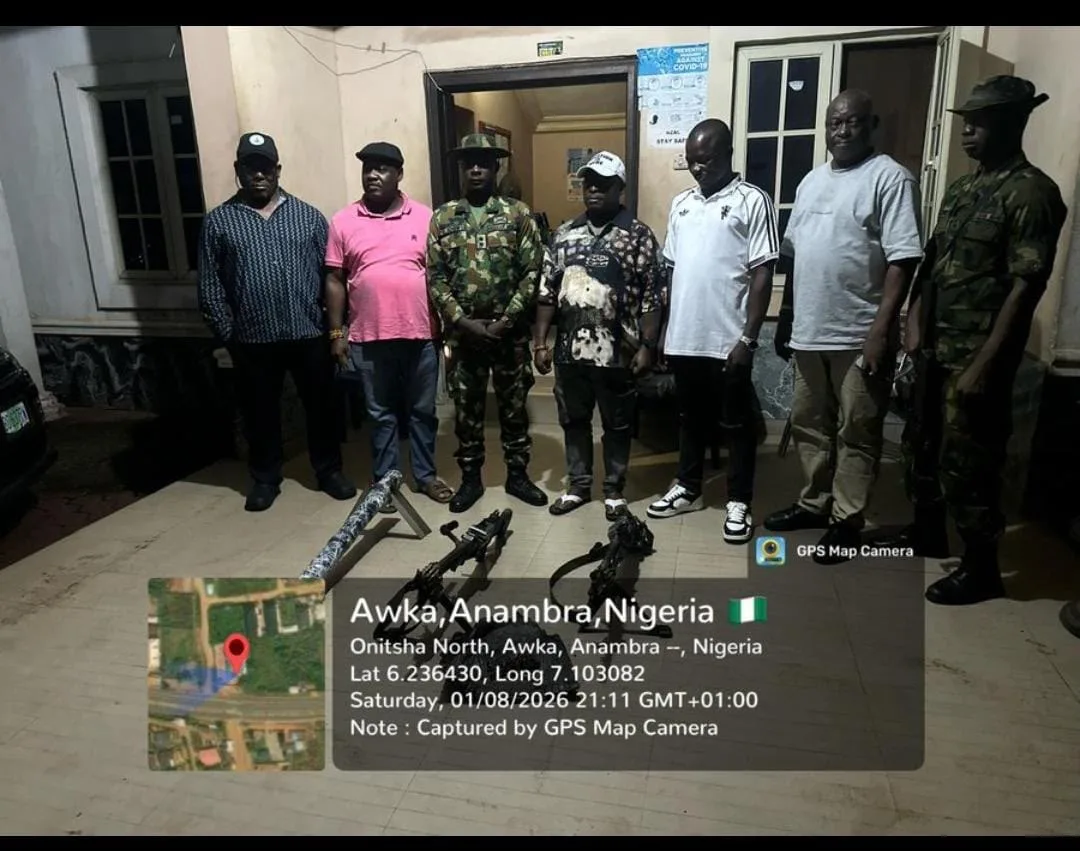
The Nigerian Army has announced that sustained military operations in the South-East have compelled members of a militant group to surrender their weapons, while intelligence-led raids also resulted in the recovery of heavy weapons and an Improvised Explosive Device (IED).
In a statement issued on Friday, the Army said the successes were recorded by troops of the 82 Division/Joint Task Force South-East, Operation UDO KA (OPUK), describing the development as another major step in efforts to dismantle criminal networks and restore peace in the region.
According to the statement, the breakthrough followed sustained pressure mounted by troops of the 34 Artillery Brigade and the recent arrest of suspects linked to the killing of a soldier.
The Army said members of a militant group operating within Egbema and its environs voluntarily surrendered their weapons after being unable to withstand the sustained military offensive.
It added that one of the suspects led troops to a concealed arms dump, where security operatives recovered one AK-47 rifle, two AK-47 magazines, 54 rounds of 7.62mm special ammunition and four locally fabricated firearms.
In a separate operation, troops of Sector 5, Operation UDO KA, acting on credible intelligence, recovered two General Purpose Machine Guns (GPMGs), 45 rounds of 7.62mm x 51 ammunition and one Improvised Explosive Device (IED).
The Army said the recoveries had further weakened the operational capacity of criminal elements, denying them the means to threaten lives and property in the region.
It described the voluntary surrender of weapons as evidence that sustained military pressure, backed by collaboration with other security agencies, is forcing criminal groups to abandon violence.
The statement reaffirmed the Nigerian Army’s commitment to sustaining ongoing operations until all criminal networks are dismantled and lasting peace and stability are restored across the South-East.
The Army also urged members of the public to continue providing timely and credible intelligence, stressing that community support remains vital to the success of ongoing security operations.