By Adesakin Adefemi
The Federal Government has disclosed that many of the terrorists responsible for violent killings across Nigeria are foreign nationals who entered the country through its porous borders.
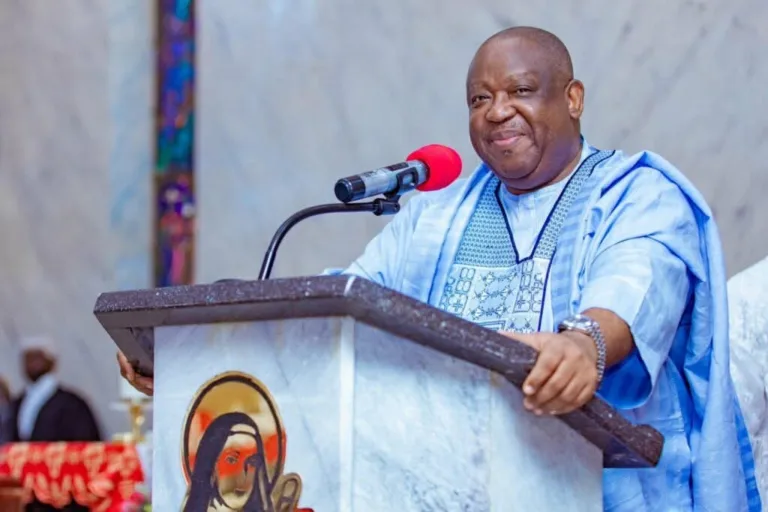
Secretary to the Government of the Federation (SGF), George Akume, made this known on Sunday while addressing participants at the First Plenary of the Catholic Bishops’ Conference of Nigeria, held at St. Gabriel’s Chaplaincy, Catholic Secretariat of Nigeria, Abuja.
Akume acknowledged that insecurity remains a major national challenge but emphasized that it is not unique to Nigeria. “Insecurity is a problem not only in this country but throughout the world. Even advanced countries are going through this,” he said, noting that the violence predates President Bola Ahmed Tinubu’s administration.
Citing security reports, Akume revealed that many suspects arrested in connection with recent attacks were not Nigerians. “Many of these people who have been arrested don’t speak English. They speak very poor Hausa, but they speak French. Do we speak French in Nigeria? No,” he said, stressing that foreign elements are deeply involved in the killings.
While clarifying that groups such as Boko Haram originated within Nigeria, he maintained that several attackers currently operating in forests and rural communities, especially in Niger State and other affected areas, are from outside the country. “Those who are doing the killings, most of them are from outside the country. I say what I know to be true based on security reports,” Akume stated.
He added that Nigeria’s recent designation as a Country of Particular Concern by the United States over security and religious freedom issues has led to increased international cooperation. According to him, recent drone strikes in Sokoto State show that the government is not passive. “It is not that we are just sitting by; America is cooperating with Nigeria. We are working together,” he said.
Akume also disclosed that President Tinubu’s recent visit to Turkey was partly to procure additional military hardware, including drones and other advanced armaments, to strengthen Nigeria’s security architecture. “The main reason the President was in Turkey was to purchase more armaments. This includes drones. So we are not just sitting idle,” he explained.
On the controversial issue of reintegrating former terrorists, the SGF clarified that such attempts were initiated under the previous administration but did not progress significantly and were eventually halted. “There were attempts to put them in the military, but that was resisted. That was not done,” he said, urging caution on any future such measures.
Akume called on stakeholders, including religious leaders, to approach insecurity with objectivity and a holistic understanding of its complexities. “You will have your own session and dissect whatever we say, but let me say what I have as a security report,” he added.
The SGF’s remarks come amid growing concerns over repeated attacks on communities, churches, and travelers, which have left thousands dead and displaced in recent years. Security analysts say his revelation about foreign involvement could shape new strategies in tackling terrorism.
Reaffirming government’s commitment, Akume stressed that Nigeria will continue to work with international partners, invest in modern weapons, and intensify intelligence gathering to secure its borders and protect citizens.