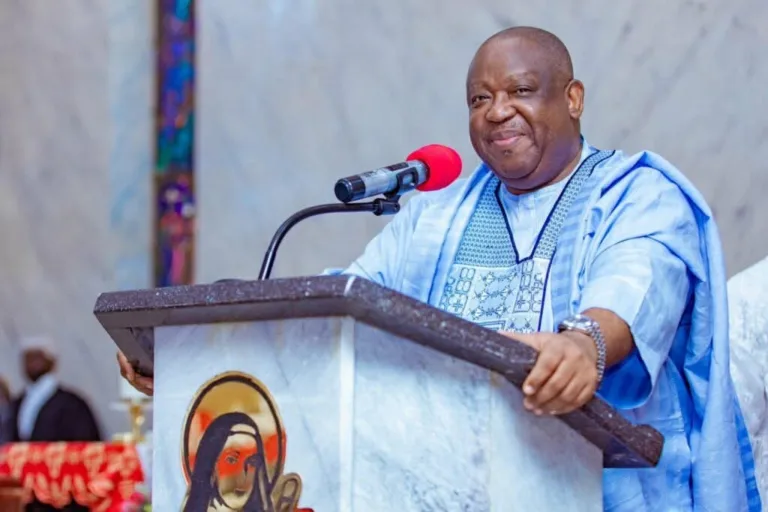
The Federal Government has reaffirmed its commitment to revitalizing Nigeria’s power sector through Public-Private Partnerships (PPP) to close a significant investment gap and achieve uninterrupted power supply across the nation.
Power Minister Adebayo Adelabu announced that Nigeria needs $10 billion in funding to attain a 24-hour power supply, a goal the government aims to reach over the next decade by leveraging private sector involvement.
Speaking during a strategic meeting with Dr. Jobson Oseodion Ewalefoh, Director-General of the Infrastructure Concession and Regulatory Commission (ICRC), Adelabu outlined the critical role of PPPs in providing the financial and technical support required for this ambitious target.
“Achieving 24-hour power supply within 10 years requires a funding commitment of around $10 billion, which the government alone cannot provide,” Adelabu stated.
“This is why we must partner with the private sector through Public-Private Partnerships, while retaining government interest.”
Dr. Ewalefoh emphasized that the PPP approach would bring not only essential funds but also the technical expertise necessary to optimize Nigeria’s power infrastructure.
“Revamping the power sector requires planning, investment, and time. Government cannot fund it alone. So, we must rely on the private sector’s financing capacity, which is why the ICRC was set up to regulate this leverage,” Ewalefoh said.
The minister noted that attacks on infrastructure, such as the recent assault on the Transmission Company of Nigeria’s (TCN) substation project in Obajana, Kogi State, and last month’s bandit-led attack on the Shiroro-Kaduna transmission line, underscore the challenges facing Nigeria’s power sector.
Adelabu and Ewalefoh agreed that PPPs could mitigate these challenges, ensuring investments in both existing and new power infrastructure while bolstering security measures.
The ICRC DG introduced a six-point policy aimed at accelerating PPP investments in the power sector, which includes stringent oversight measures to prevent delays and ensure compliance.
Under the ICRC framework, PPP agreements now include conditions that, if unmet, lead to automatic nullification, ensuring only capable firms participate.
Ewalefoh remarked, “Our regulatory framework streamlines the process of attracting PPP investment to the sector, boosting foreign direct investment and driving economic growth.”
With these initiatives, the Federal Government and the ICRC are optimistic about advancing towards the goal of regular electricity supply and transforming Nigeria’s power sector over the next decade..